Meditation Positions: How to Sit, Kneel or Lie Comfortably
Meditation positions compared: chair, cross-legged, Burmese, lotus, kneeling, standing and lying down, plus hand positions and the posture mistakes to avoid.
- Duration
- 4 min
- On the menu
The best meditation position is one that keeps you upright, stable and alert without strain, and for many people that is simply a chair. Cross-legged poses, kneeling and lotus are traditional, but none of them is required. What matters more than the shape of your legs is a relaxed, fairly upright spine, steady support beneath you and a posture you can hold for the length of your session without gritting your teeth.
Common positions compared
| Position | Support | Good for | Watch out for |
|---|---|---|---|
| Chair | Firm seat, feet flat | Beginners, stiff hips, offices | Slumping into the backrest |
| Easy cross-legged | Cushion under the hips | Short sessions on the floor | Knees higher than hips |
| Burmese | Cushion; both shins on the floor, one in front of the other | Longer floor sits | Needs some hip openness |
| Half and full lotus | Cushion; one or both feet on the opposite thigh | Very flexible practitioners | Knee strain if forced |
| Kneeling (seiza) | Bench or upright cushion between the heels | A naturally straight back | Numb feet, ankle pressure |
| Standing | Feet hip-width, knees soft | Drowsiness, short breaks | Locking the knees |
| Lying down | Mat or bed, knees optionally bent | Body scans, pain, evenings | Falling asleep |
Sitting in a chair
Choose a chair with a flat, firm seat. Sit towards the front edge so your back supports itself, feet flat on the floor and roughly hip-width apart. If your feet do not reach comfortably, put a folded blanket or a book under them. A small cushion behind the lower back is fine if you prefer to lean. This is the pose taught in many secular mindfulness courses, and it is every bit as valid as sitting on the floor.
Floor positions
Easy cross-legged and Burmese
Sit on the front third of a firm cushion so your hips are lifted above your knees. That tilt lets the lower back keep its natural curve. In an easy cross-legged pose the shins cross; in the Burmese position both shins rest on the floor, one in front of the other, which many people find kinder to the knees. If a knee hangs in the air, prop it with a rolled towel.
The lotus position
In half lotus, one foot rests on the opposite thigh; in full lotus, both do. These positions are very stable for people whose hips allow them, but the twisting load lands on the knee if the hips are not open enough. Never force a foot into place, and back off at once if you feel pain in the knee. A lotus is a result of flexibility, not a test of commitment.
Kneeling
Kneeling, known in Japan as seiza, keeps the spine upright with little effort. A low wooden bench or a cushion turned on its side between the heels takes the weight off the ankles. A folded blanket under the shins softens a hard floor.
Standing and lying down
Standing meditation is useful when you are sleepy or have been sitting all day. Keep your feet under your hips, soften the knees and let the arms hang. Lying on your back is ideal for a body scan, when pain makes sitting hard or at bedtime, though sleep tends to win if you are tired. Bending the knees with the feet flat helps you stay a little more awake.
A quick posture checklist
- Base: stable, with hips at or above knee height.
- Spine: upright but not rigid, as if gently stacked.
- Shoulders: relaxed down and back, with no lifting.
- Chin: slightly tucked, so the back of the neck is long.
- Jaw and face: loose, teeth apart, tongue resting.
- Eyes: closed, or open with a soft downward gaze.
- Hands: resting where the arms feel weightless.
Where to put your hands
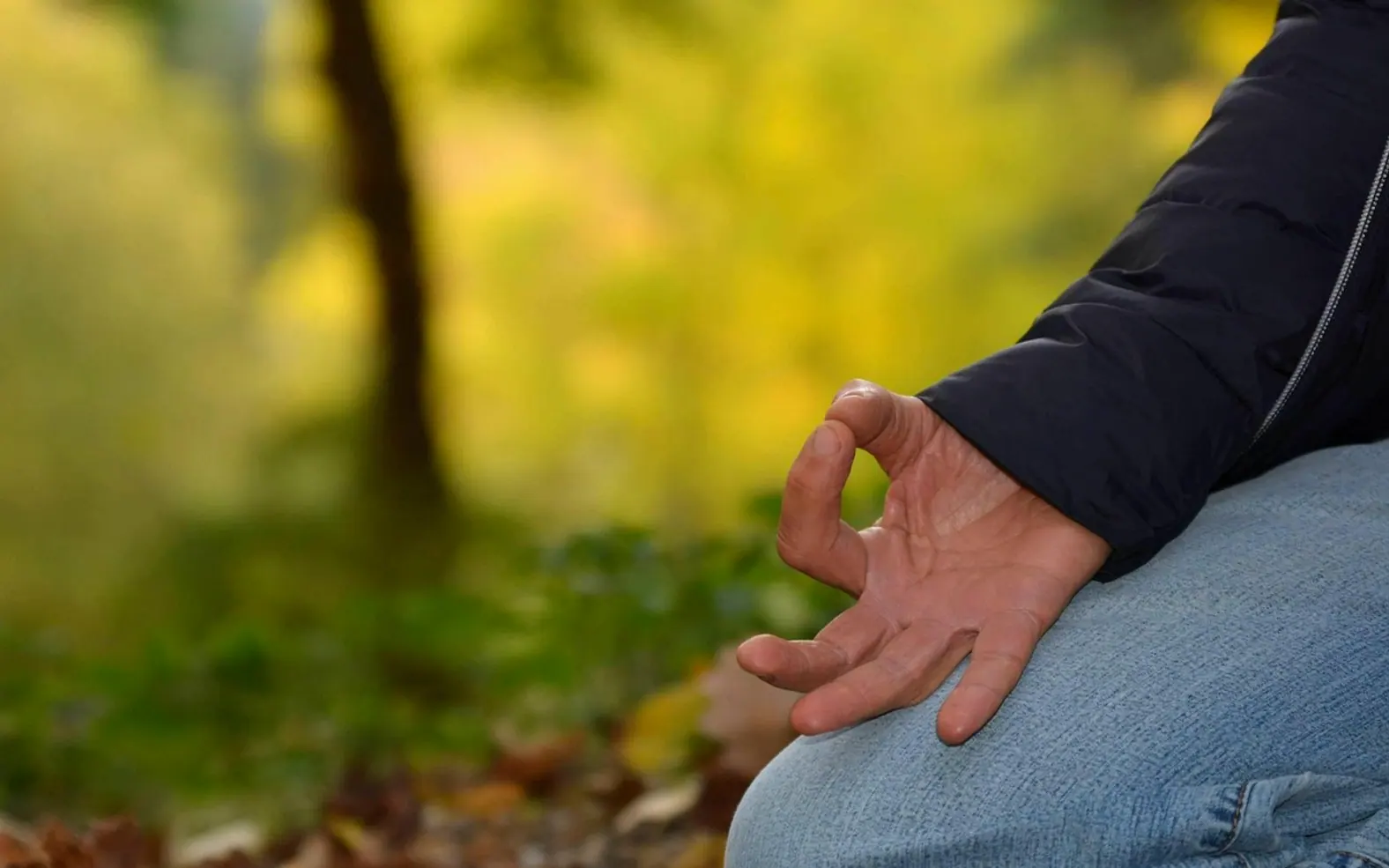
The simplest option is to rest the hands palm down on the thighs, which feels grounding, or palm up, which some find more open. In the "cosmic" hand position common in Zen, the left hand rests in the right, palms up, with the thumb tips lightly touching to form an oval. In the gesture often called gyan mudra, the tip of the index finger touches the thumb, with the other fingers relaxed. Hand positions such as these, called mudras, carry symbolic meanings in various traditions; for practical purposes, choose whichever lets your shoulders stay soft.
Mistakes that make sitting harder
- Forcing an impressive floor pose and spending the session in discomfort.
- Sitting so straight that the back aches within minutes.
- Letting the head drop forward, which pulls on the neck.
- Refusing to move at all. Adjusting slowly and mindfully is part of the practice.
If you have a knee, hip or back condition, a physiotherapist can suggest the safest options for you. Regular stretching helps, too; the gentle routine in our article on yoga for everyday life opens the hips over time. Once you have found a comfortable seat, the beginner's guide to meditation explains what to do with your attention, and a dedicated meditation corner makes it easier to come back to the same spot each day.